
TrueLink® DNA Library Prep Kit
End Repair-Free NGS Library Preparation
-
Preserve the Molecule.
-
Reduce Artifacts.
-
Reveal More Biology.
- Preserve the Molecule.
- Reduce Artifacts.
- Reveal More Biology.
Sequencing accuracy begins at the molecule.
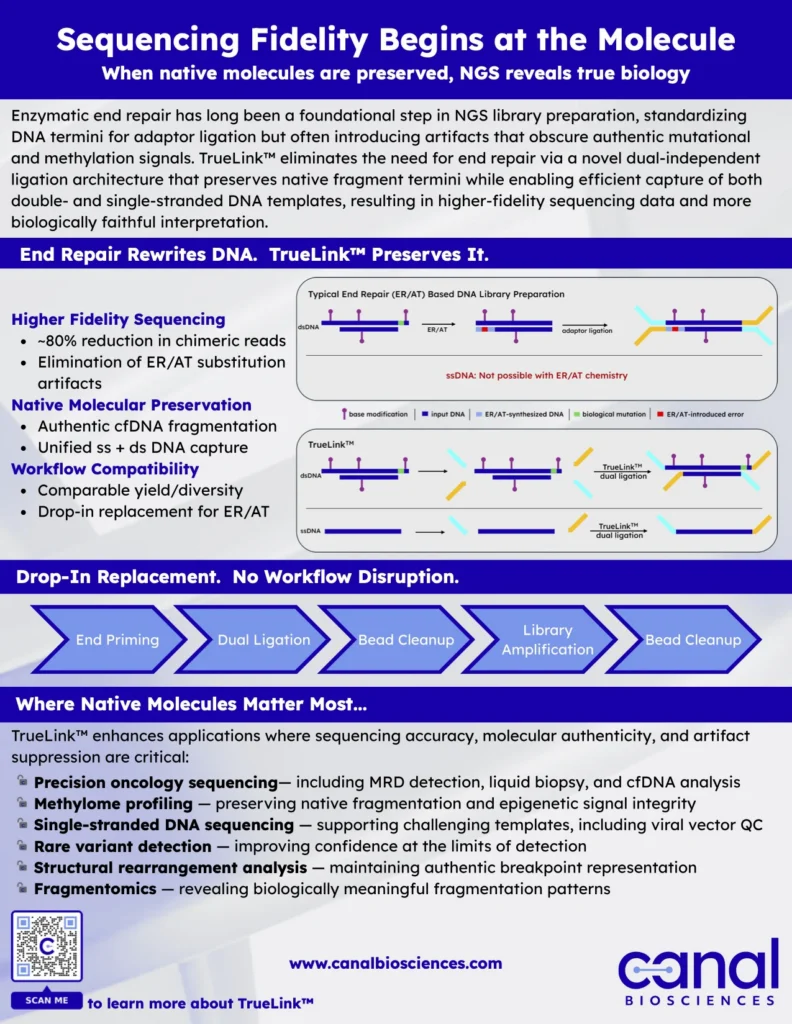
The TrueLink® DNA Library Prep Kit puts native molecule preservation into practice. Using dual direct and independent ligation, it attaches adapters directly to native DNA termini without conventional end repair or A-tailing.
The kit prepares Illumina-compatible libraries from single-stranded and double-stranded DNA, with amplification after adapter ligation. Review the workflow and performance data below to assess its fit for your samples and research objectives.
Read more
The result is sequencing data that more faithfully reflects the original input molecule: fewer preparation-induced artifacts, reduced end-associated errors, lower chimera formation, preserved cfDNA fragmentation features, and broader capture of native DNA populations, including single-stranded templates.
For applications where small molecular differences can carry significant biological meaning, TrueLink helps ensure that the library preparation step preserves signal rather than rewriting it.
Molecular
authenticity
Remove ER/AT-driven resynthesis from DNA library preparation.
Fragmentomics signal preservation
Preserve native fragment termini and end-associated molecular information.
Artifact
reduction
Reduce preparation-induced chimeras and end-associated substitution errors.
Broader template conversion
Capture both single-stranded and double-stranded DNA populations.
Workflow integration
Fit into standard Illumina®-compatible sequencing workflows.
How TrueLink® Works
Native molecule library preparation without end repair or A-tailing.
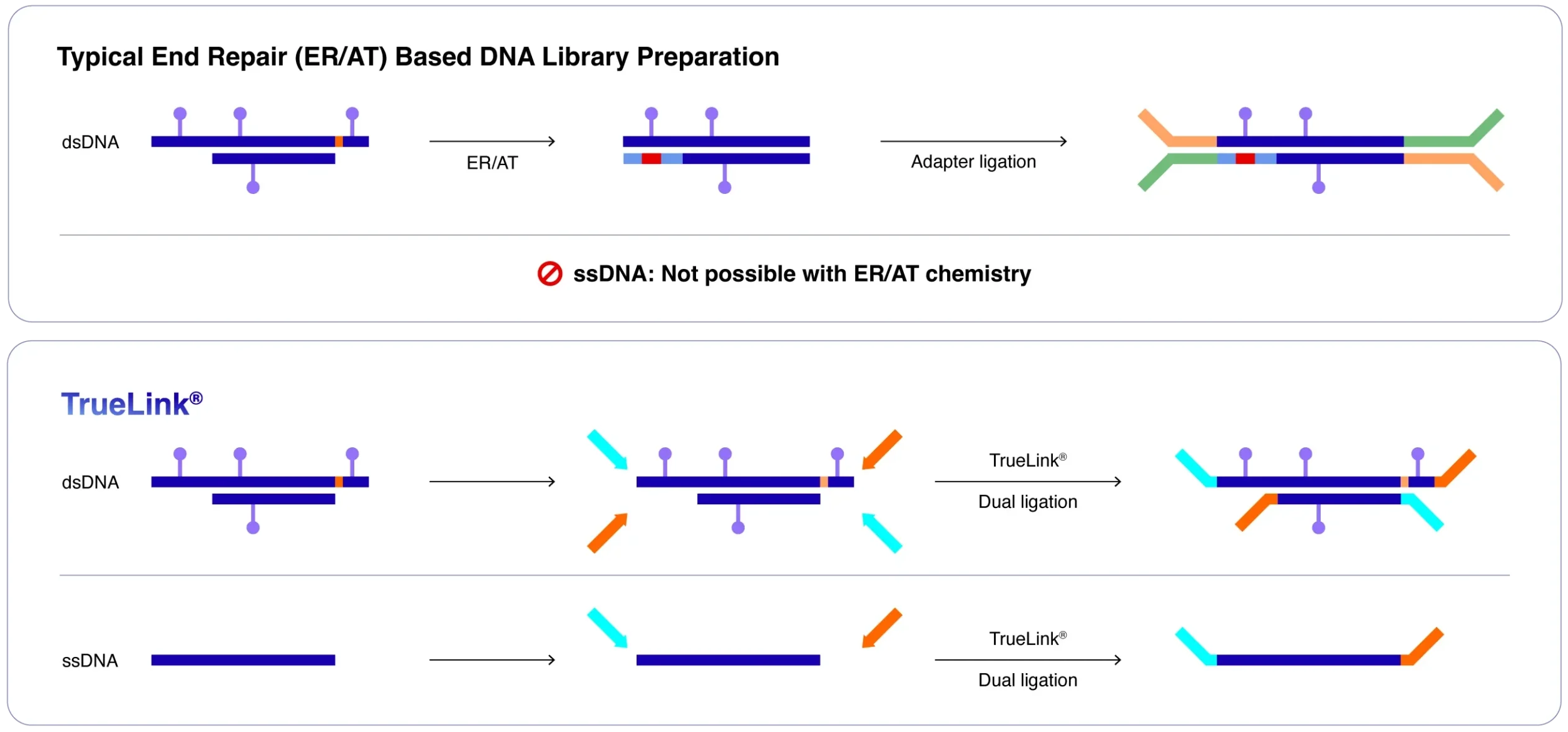
TrueLink® uses a different strategy for DNA library preparation. Instead of first reshaping DNA fragment ends through conventional end repair/A-tailing, TrueLink® prepares native DNA molecules for dual direct and independent ligation.
This approach enables adapters to be joined directly to native 5′ and 3′ DNA termini using distinct adapter/ligase systems. The result is an end repair-free workflow designed to preserve native fragment end structure.
Why It Matters
Conventional ER/AT-based workflows make DNA compatible with sequencing by enzymatically modifying the molecule before adapter ligation. TrueLink® eliminates that template-rewriting step. By preserving native DNA termini from the start of library preparation, TrueLink® is designed to reduce library prep-induced artifacts, retain biologically meaningful fragment structure, and support higher-fidelity sequencing analysis.
- Direct adapter ligation: Adapters are ligated to native DNA termini without end repair, fill-in, trimming, or A-tailing.
- Independent 5′ and 3′ ligation: TrueLink® uses distinct adapter/ligase systems for 5′-end and 3′-end ligation. These reactions can be performed together or separately depending on workflow requirements.
- Native molecule preservation: By avoiding ER/AT-driven template rewriting, TrueLink® helps preserve fragment-end information that conventional workflows alter, overwrite, or obscure.
- Broader DNA capture: TrueLink® generates libraries from both double-stranded and single-stranded DNA present in the input sample.
Workflow at a Glance
TrueLink® DNA Library Preparation

Prepare the input
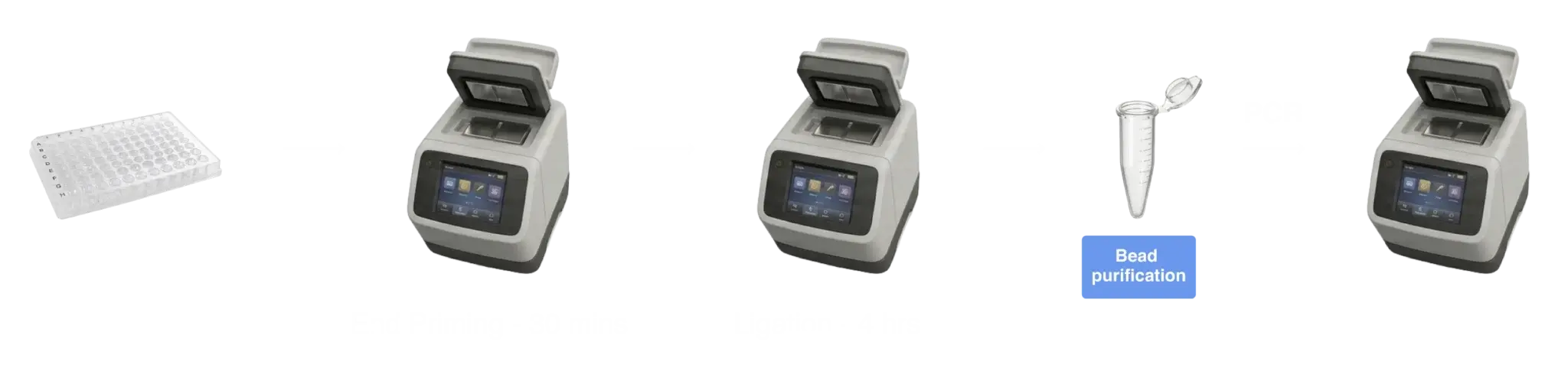
Start with pre-sheared DNA or biologically fragmented DNA, such as cfDNA. TrueLink® End Priming prepares molecules for dual direct and independent ligation without conventional end repair or A-tailing.

Ligate adapters directly
Attach adapters to native 5′ and 3′ DNA termini using TrueLink® dual direct and independent ligation chemistry.

Generate
the library
Clean up, amplify, and produce an Illumina-compatible P5/P7 sequencing library.
Performance data for TrueLink® DNA Library Preparation
Native Molecule Preservation Produces Higher-Fidelity Sequencing Data
TrueLink® was designed to eliminate a major source of library-preparation artifacts: enzymatic end repair and A-tailing. By attaching adapters directly to native DNA termini through dual direct and independent ligation, TrueLink® preserves molecular features that conventional ER/AT workflows alter, overwrite, or obscure.
The figures below evaluate TrueLink® across genomic DNA, cfDNA, and single-stranded DNA spike-in models. Together, the data shows that TrueLink® maintains high library diversity while reducing ER/AT-associated artifacts and preserving native molecular features that can be altered by conventional workflows.
In Canal Biosciences internal evaluation datasets, TrueLink demonstrated:
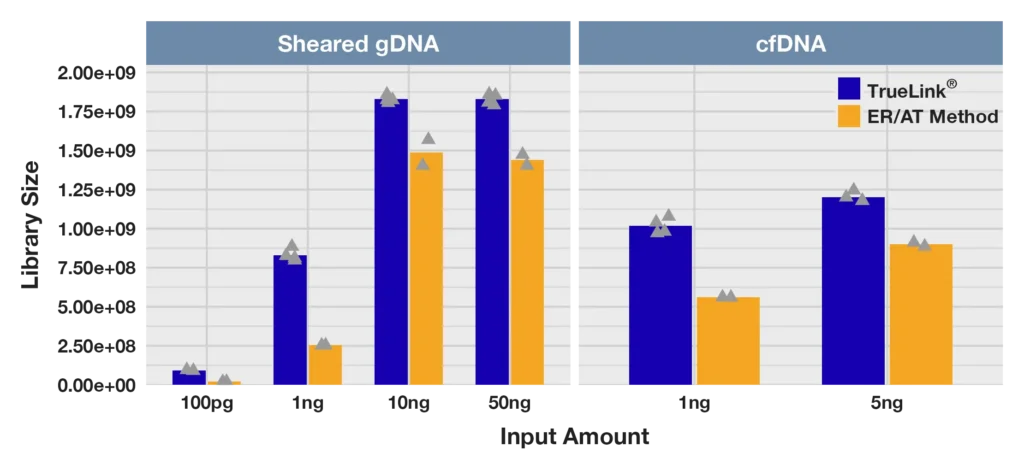
- High library diversity across sheared gDNA and cfDNA inputs.
- >80% fewer chimeric reads compared with ER/AT-based preparation.
- Reduced ER/AT-associated Read 2 substitution errors.
- Preservation of cfDNA fragmentation features relevant to fragmentomics research.
- Capture of single-stranded DNA in mixed DNA populations.
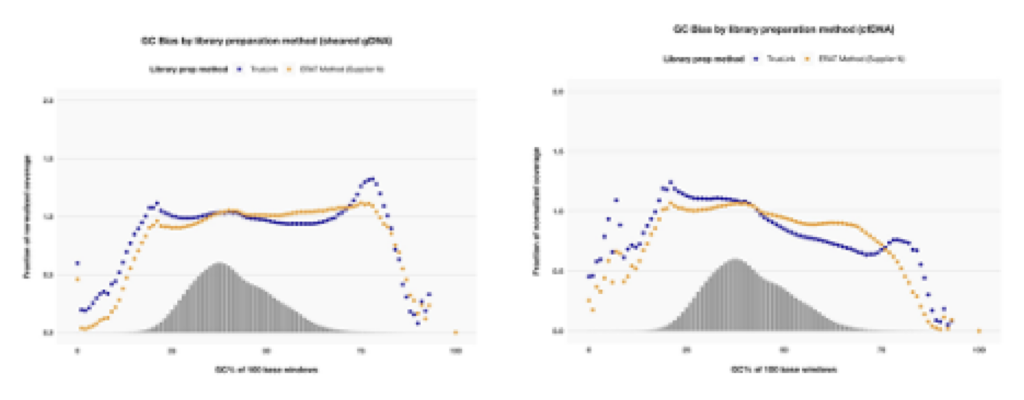
- Even GC coverage across sheared gDNA and cfDNA inputs.
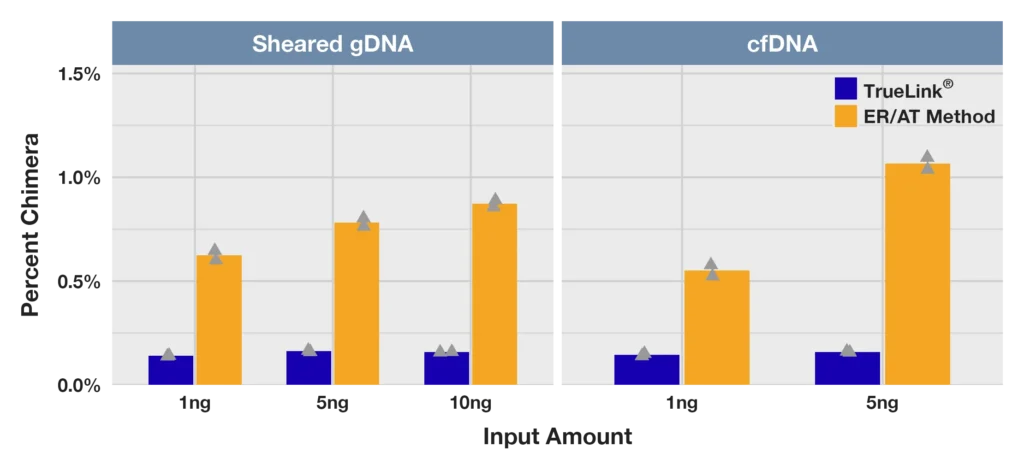
TrueLink Reduces Chimeric Reads
TrueLink reduced chimeric reads by >80% and showed chimera rates that were largely independent of input amount, in contrast to the ER/AT method. Lower chimera rates may support more confident downstream interpretation of indels and structural rearrangements in research applications.
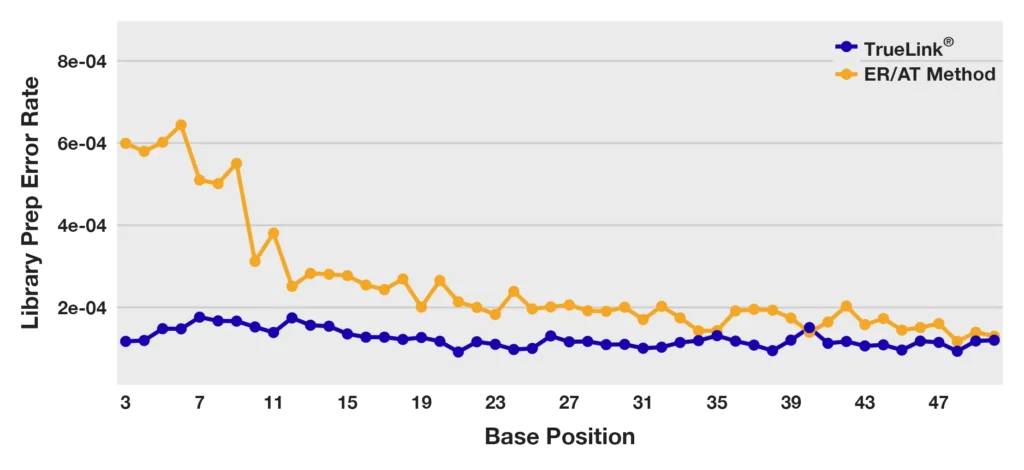
TrueLink Reduces Read 2 ER/AT Substitution Errors
TrueLink markedly reduced polymerase-driven, ER/AT-related substitution errors in Read 2. Error rate represents library-prep errors calculated from overlapping Read 1/Read 2 consensus data using NA12878. The benefit of error rate reduction extends into the insert sequence. Note: Bases 1 and 2 are trimmed in both samples.
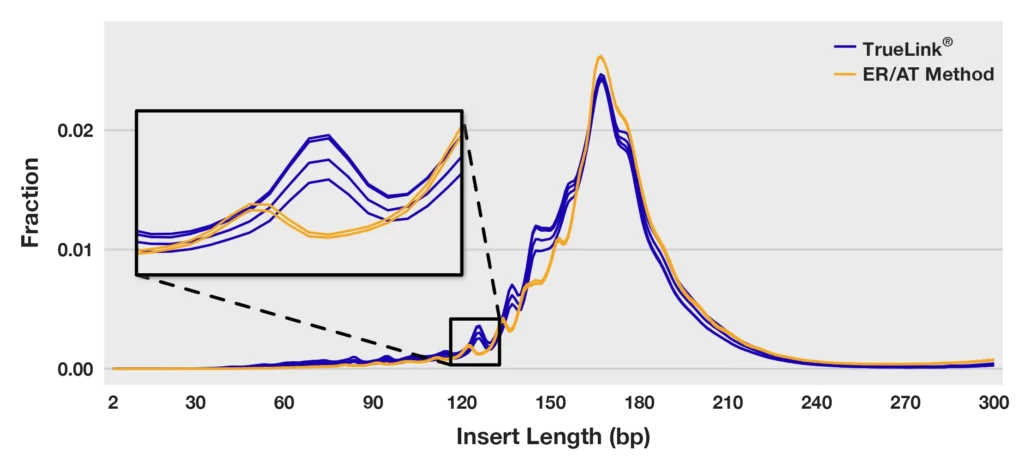
TrueLink Reveals Native cfDNA Fragmentation Pattern
TrueLink insert-size distribution closely follows ER/AT-based methods while revealing a shifted 10 bp periodicity pattern between 100–166 bp, consistent with preservation of native cfDNA fragmentation features.
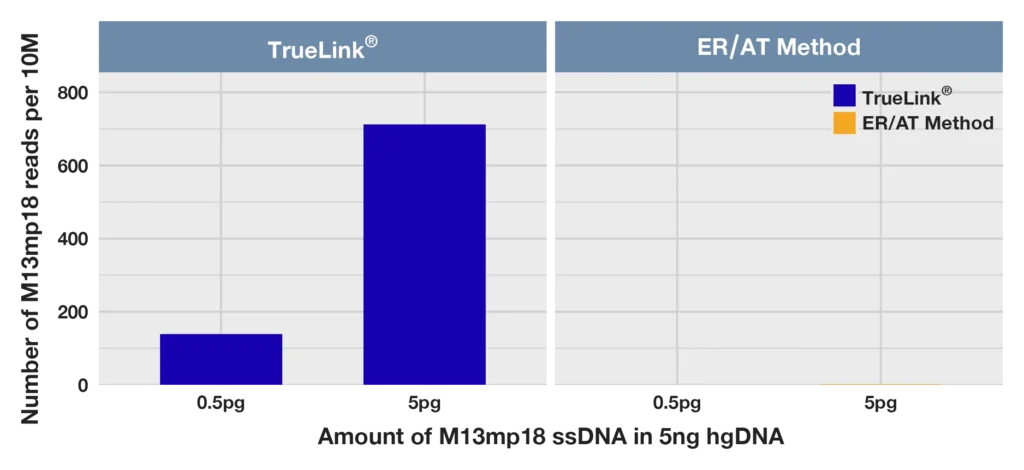
TrueLink Captures ssDNA
TrueLink captures M13 single-stranded DNA spiked into a double-stranded hgDNA library, while the ER/AT-based method did not detect the ssDNA spike-in.
TrueLink Produces Even Coverage Across the GC Spectrum
Whole-genome sequencing profiles show no significant GC-content-associated coverage bias with TrueLink across sheared gDNA and cfDNA inputs compared with ER/AT-based preparation.
Product Ordering
| Product Description | Catalog # | Reactions |
|---|---|---|
|
TrueLink® DNA Library Prep Kit-24 |
TL0001-24 |
24 reactions |
|
TrueLink® DNA Library Prep Kit-96 |
TL0001-96 |
96 reactions |
To request a quote or discuss a customized TrueLink® workflow, call 877-TRU-LNK0 or contact Canal Biosciences.
Product Resources
TrueLink® DNA Library Prep Kit FAQs
What applications is TrueLink® designed for?
Does the TrueLink® DNA Library Prep Kit include purification beads?
No. Purification beads are not included. Users must supply SPRI-based purification beads. Recommended: AMPure XP Beads, Beckman Coulter Life Sciences, Cat. #A63880.
Does the TrueLink® DNA Library Prep Kit include PCR reagents?
No. PCR reagents and indexing primers are not included. Users must supply compatible amplification reagents and indexing primers. Recommended: KAPA HiFi HotStart ReadyMix, Roche, Cat. #KK2602 / KK2601; xGen™ UDI Primers, IDT, Cat. #10005975 / #10005922.
Does the current TrueLink® kit support PCR-free library preparation?
Can the TrueLink® ligation time be shortened?
Do TrueLink® adapters contain UMIs?
Can I use my own Y-adapter with the TrueLink® kit?
Can TrueLink® preserve duplex strand-pairing information?
Can I tell whether a sequenced molecule originated as single-stranded or double-stranded DNA?
What is the best way to quantify TrueLink® libraries?
Canal recommends qPCR-based library quantification for the most accurate measurement of sequenceable library molecules. Fluorometric methods such as Qubit can be useful for estimating total DNA mass, and fragment analysis methods such as TapeStation or Fragment Analyzer are useful for assessing library size distribution. Recommended options include KAPA Library Quantification Kit, Qubit dsDNA HS Assay Kit, and Agilent High Sensitivity D1000 ScreenTape.
What should I do if I see adapter dimer?
Adapter dimer may be observed as a low-molecular-weight peak during final library size assessment, particularly with very low input amounts. Where feasible, using more than 1 ng of input DNA may reduce adapter dimer burden. If adapter dimer is present after amplification and cleanup, a second post-library purification may be performed. For low-input applications where adapter dimer mitigation is prioritized, reduced bead cleanup ratios may be considered, but this may also reduce recovery of smaller library fragments, total yield, and library diversity.
What should I do if I see precipitate in the Quench Buffer?
Precipitation during storage at 2–8°C is normal. Before use, incubate the Quench Buffer at 37°C for 5 minutes and mix gently until fully resuspended.
How should TrueLink® reagents be stored?
Legal and Disclaimers
Products, technologies, workflows, data, figures, trademarks, and related content described on this page are protected by one or more patents, patent applications, trademarks, copyrights, trade secrets, and/or other intellectual property rights owned or controlled by Canal Biosciences Inc. (“Canal”). The purchase or use of any Canal product conveys no license, express or implied, under any Canal intellectual property or third-party intellectual property rights, except as expressly stated in Canal’s applicable Product & Service Terms and Conditions or other written agreement.
TrueLink® products are intended for Research Use Only and are not intended for use in diagnostic procedures, clinical decision-making, therapeutic applications, or administration to humans or animals. References to potential applications, including liquid biopsy, methylation profiling, rare variant detection, structural variant analysis, fragmentomics, single-stranded DNA analysis, or other sequencing applications, are provided for research-use and informational purposes only and do not constitute clinical validation, diagnostic performance claims, regulatory clearance or approval, or fitness for any particular use.
Performance may vary by sample type, input amount, DNA quality, fragmentation method, workflow conditions, sequencing platform, assay design, and analysis method. Users are responsible for determining whether Canal products are suitable for their intended research use and whether any additional third-party rights, approvals, licenses, or permissions are required.
Purchases, evaluations, custom products, services, and product use are subject to Canal Biosciences’ applicable Product & Service Terms and Conditions or other written agreement. For more information, please contact info@canalbiosciences.com.
